

Building Trust from Clean Data to Automated Decision-Making
Data & AI Maturity Starts with Trust
THE DATA & AI MATURITY CURVE
The maturity curve illustrates how organizations evolve their data and analytics capabilities while competitive advantage and trust increase at every stage.
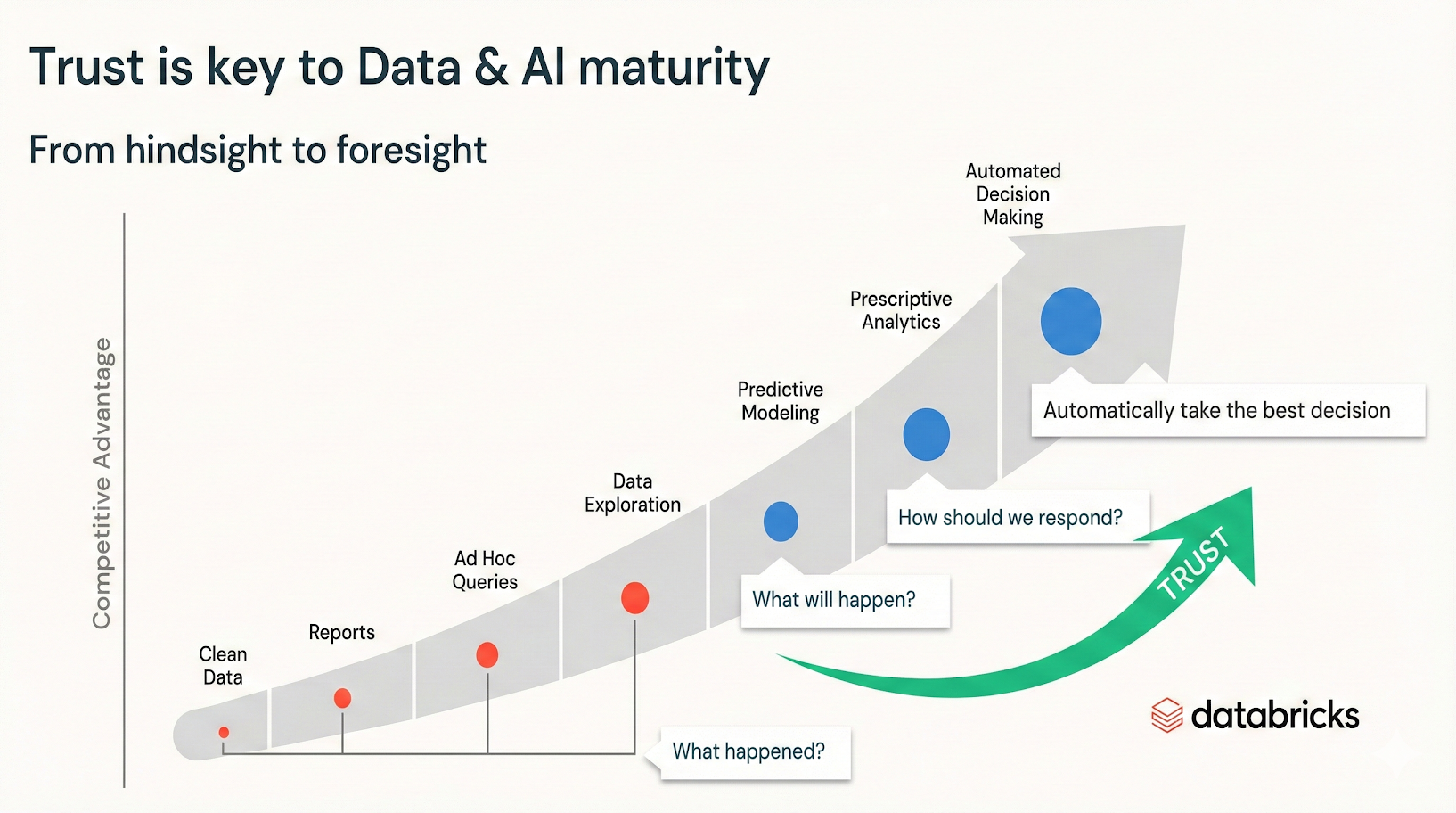
Clean Data
Foundation for Trust
Enterprise data is integrated across applications with standardized schemas and governance. Data quality, consistency, and lineage are established to reduce operational risk.
This stage ensures analytics and AI are built on reliable, auditable data.
When an organization reaches this stage:
Data reliability is no longer questioned in executive discussions. Teams spend time using data rather than preparing it.
Data reliability is no longer questioned in executive discussions. Teams spend time using data rather than preparing it.
Reports
Consistent Visibility
Standardized reports and dashboards deliver a single version of the truth.
Key performance indicators are defined and aligned across business units.
Analytics remains descriptive but trusted.
When an organization reaches this stage:
Leadership reviews consistent dashboards across teams. Performance discussions are anchored in shared metrics.
Leadership reviews consistent dashboards across teams. Performance discussions are anchored in shared metrics.
Ad-hoc Queries
Responsive Analysis
Business users access data to answer specific operational questions.
Self-service analytics reduces dependency on IT for routine insights.
Analysis is reactive and driven by immediate business needs.
When an organization reaches this stage:
Teams investigate issues faster and with greater autonomy. Analytics supports operational problem-solving, not long-term planning. AI Enablement using Azure Machine Learning and analytics services. Model development integrated with enterprise data pipelines.
Teams investigate issues faster and with greater autonomy. Analytics supports operational problem-solving, not long-term planning. AI Enablement using Azure Machine Learning and analytics services. Model development integrated with enterprise data pipelines.
Data Exploration
Insight Discovery
Advanced analytics enables pattern discovery and root-cause analysis. Organizations begin identifying leading indicators and behavioral trends. Analytics transitions from descriptive to diagnostic and early predictive use.
When an organization reaches this stage:
Business and analytics teams collaborate on insight generation. Decisions rely on discovered trends rather than intuition.
Business and analytics teams collaborate on insight generation. Decisions rely on discovered trends rather than intuition.
Predictive Modeling
Forward-Looking Intelligence
Statistical and machine learning models forecast outcomes and risks.
Organizations anticipate future demand, performance, and operational impacts.
Analytics becomes a strategic input into planning and investment decisions.
When an organization reaches this stage:
Leadership plans based on forecasts, not historical averages. Scenario analysis informs strategic decisions across functions.
Leadership plans based on forecasts, not historical averages. Scenario analysis informs strategic decisions across functions.
Prescriptive Analytics
Decision Optimization
Analytics recommends optimal actions based on predicted outcomes.
Decision logic incorporates constraints, costs, and business objectives.
Insights evolve into actionable guidance.
When an organization reaches this stage:
Teams receive clear, data-backed recommendations. Decision cycles shorten and become more consistent.
Teams receive clear, data-backed recommendations. Decision cycles shorten and become more consistent.
Automated Decision-Making
AI-Driven Operations
AI systems automatically execute decisions within defined guardrails.
Human oversight focuses on exceptions, governance, and strategy.
This stage represents the highest level of data and AI maturity.
When an organization reaches this stage:
Operational decisions occur in real time. The organization scales efficiently with minimal manual intervention.
Operational decisions occur in real time. The organization scales efficiently with minimal manual intervention.
Why Most AI Initiatives Stall Before Delivering Value
Many organizations invest in analytics and AI tools but struggle to move beyond basic reporting. The root cause is not lack of ambition, it's lack of trust in data.
Inconsistent or poor-quality data across systems
Manual reporting that answers only 'what happened'
Limited confidence in insights generated by analytics tools
AI models that cannot be operationalized due to weak data foundations
Without trust, organizations remain stuck in hindsight—unable to confidently predict or automate decisions.
CLOUDFRONTS APPROACH
A Structured, Execution-Driven Approach
CloudFronts follows a proven, step-by-step delivery approach that ensures clarity, quality, and scalability at every stage of your data and AI journey.
Structured Requirement Gathering
We begin with a structured requirement discovery process using predefined and proven questionnaires, supplemented by ad-hoc questions where deeper clarification is required.
Read more- Standardized report discovery questions are used across all reports
- Requirements are documented in Functional Requirement Documents (FRDs) and translated into project tasks
- Focus is placed on understanding the purpose of each report and the business decisions it supports
Stakeholder & Process Alignment
Alignment across business and technical teams is critical to build trust in data.
Read more- Identify business, functional, and technical owners
- Align on objectives, scope, and expectations
- Review existing systems, reports, data sources, and manual processes
- Understand business workflows to see how data is created, maintained, and consumed
Deep Discovery Using CloudFronts Blueprints
We leverage CloudFronts Data Ready Blueprint and discovery frameworks during pre-sales and delivery to accelerate clarity.
Read more- Report-level technical discovery
- Master Data Management (MDM) discovery
- Identification of KPIs, data sources, refresh frequency, historical needs, and validation rules
All requirements are classified based on business criticality, usage frequency, and complexity, and reviewed with stakeholders for formal sign-off before development begins.
Agile Development & Iterative Delivery
Development follows an Agile delivery model with 2-week sprints to ensure transparency and adaptability.
Read more- User stories and tasks tracked in Azure DevOps
- Daily Scrum calls to track progress and resolve blockers
- Sprint demos conducted with business stakeholders
- Sprint retrospectives used to continuously improve delivery
Measurable outcomes include sprint reports showing stories committed vs. delivered ensuring accountability and predictability.
Built-in Data Quality & Functional Validation
Data trust is reinforced through rigorous functional and data quality testing.
As part of validation:
Read more- Data quality checks are implemented within Databricks
- Record counts, mandatory fields, data types, duplicates, and business rules are validated
- Reconciliation is performed against source systems to ensure completeness and accuracy
This ensures downstream analytics and AI models are built on reliable data.
Controlled Deployment & CI/CD
CloudFronts follows a secure and controlled deployment approach.
Read more- Code maintained in Azure Repos with enforced branch policies
- Pull requests require quality checks and approvals
- CI/CD pipelines manage deployments across environments
- Production releases occur only after formal approvals
- Release tagging and branching support hotfix management
- Automated alerts notify teams of validation or deployment failures
This minimizes risk while enabling faster, reliable releases.
Ongoing Stability & Operational Support
Post-deployment, CloudFronts ensures solution stability and business continuity through structured support.
Support activities include:
Read more- Data pipeline monitoring and failure resolution
- Data quality issue investigation and fixes
- Minor enhancements and configuration changes
- Incident and service request management
This keeps analytics and AI systems reliable as usage scales.
Governance with RACI-Based Ownership
To ensure accountability, CloudFronts defines a RACI matrix across the engagement.
Read more- Clear ownership for every activity
- Reduced overlap and ambiguity
- Better collaboration between CloudFronts and customer teams
- Strong governance throughout delivery and support
This structure ensures smooth execution from discovery to operations.
Why This Approach Matters
- Trust is built early and reinforced continuously
- Organizations don't skip foundational maturity steps
- Analytics and AI initiatives are scalable and sustainable
- Business and technical teams stay aligned throughout
SUCCESS STORIES
Explore how CloudFronts has helped organizations strengthen data foundations, improve analytics maturity, and prepare for AI-driven decision-making.

Enabling Trusted, Connected Data
- Unified systems using Azure Integration Services
- Improved access to reliable business data
- Built a foundation for innovation and analytics maturity

Executing Data & Analytics Modernization at Scale
- Strengthened data foundations
- Improved analytics maturity
- Prepared for AI-driven decision-making
WHY CLOUDFRONTS
A Trusted Partner for Your Data & AI Maturity Journey
CloudFronts combines strategy, engineering, and Microsoft platform expertise to help organizations build trust in data and move confidently toward AI-driven outcomes.
We don't just explain the curve, we help you progress along it.
Proven execution across mid-sized enterprises
Deep experience with Azure, Power BI, and data integration
Business-first, maturity-led approach
Know Where You Stand. Know What Comes Next.
Whether you're strengthening data foundations or preparing for AI-led automation, CloudFronts helps you take the next step with clarity.
FREQUENTLY ASKED QUESTIONS
Everything You Need to Know
What is Data & AI Maturity, and why does it matter?
Data & AI maturity reflects how effectively an organization can trust, use, and scale its data for decision-making and automation. Higher maturity enables faster insights, better predictions, and AI-driven decisions, while lower maturity often leads to manual reporting, inconsistent data, and stalled AI initiatives.
Do we need to reach full maturity before using AI?
No. However, AI success depends on the right level of data readiness. CloudFronts helps organizations assess their current maturity and focus on the next logical step, ensuring clean, reliable data before scaling predictive or prescriptive AI use cases.
How does CloudFronts assess our current Data & AI maturity?
CloudFronts uses a structured discovery approach that includes standardized questionnaires, stakeholder interviews, system reviews, and data assessments. This helps identify gaps in data quality, integration, analytics, and governance, forming a clear maturity baseline and roadmap.
What platforms and technologies does CloudFronts use?
CloudFronts primarily works with Microsoft technologies, including Azure Integration Services, Databricks, Azure DevOps, and Power BI, to build scalable, secure, and AI-ready data platforms.
How do you ensure data quality and trust throughout the lifecycle?
Data quality is embedded into every stage—from requirement gathering to testing and deployment. Validation checks, reconciliation with source systems, and business rule enforcement are implemented within Databricks to ensure accuracy, completeness, and consistency.
How do you manage changes in requirements during the project?
CloudFronts follows an Agile approach, allowing changes to be prioritized and incorporated into future sprints. Regular sprint reviews and retrospectives ensure evolving business needs are addressed without disrupting delivery.
How does this approach help me modernize data without disrupting existing systems?
CloudFronts starts by understanding your current architecture, integrations, and workflows before recommending changes. The approach is incremental and Agile, allowing modernization without large-scale disruption or platform replacement.
What happens after the solution goes live?
Post-deployment, CloudFronts provides operational support, including data pipeline monitoring, incident management, data quality issue resolution, and minor enhancements to ensure stability and business continuity.
How are roles and responsibilities managed between teams?
A RACI matrix is defined at the start of the engagement to clearly establish who is Responsible, Accountable, Consulted, and Informed for each activity. This ensures accountability, transparency, and smooth collaboration throughout delivery and support.
How do you manage security and governance across the data platform?
Security and governance are embedded into the solution design, including access controls, environment separation, CI/CD approvals, and data validation rules—ensuring compliance without slowing delivery.
Get access to Data-Ready Blueprint
Turn complex data into future-ready AI solutions

Anil Shah, CEO
Lorem ipsum dolor sit amet, consectetur adipiscing elit. Ut elit tellus, luctus nec ullamcorper mattis, pulvinar dapibus leo.